
Spectrophotometers
Essential Instruments for Light-Based Chemical Analysis
Spectrophotometers for chemical testing are versatile scientific instruments used to measure the absorption, transmission, or reflection of light by substances as a function of wavelength. They are invaluable tools in various fields, including chemistry, biology, physics, and environmental science. Here’s an overview of spectrophotometers:
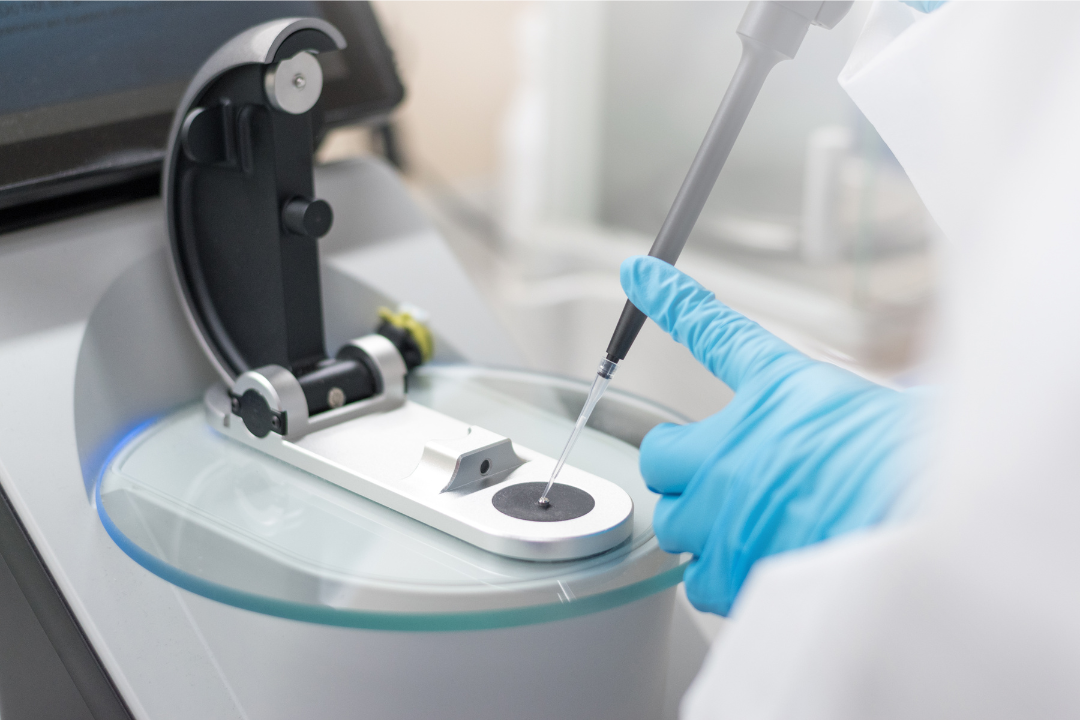
Monochromator
Selectively isolates individual wavelengths from the light source.
Sample Compartment
Where the sample is placed for analysis
Detector
Converts the light intensity into an electrical signal.
Display and Data Output
Presents the results as a spectrum and may have options for data storage and export.
Working Principles
- Spectrophotometers work based on the principles of spectroscopy, which involves the interaction between light and matter.
- A light source emits a broad range of wavelengths, often from ultraviolet (UV) to visible (VIS) to near-infrared (NIR) regions.
- The emitted light passes through or interacts with a sample.
- A detector measures the intensity of the light after it has passed through the sample.
- The instrument then generates a spectrum, which is a plot of light intensity as a function of wavelength.
Key Features
- Wavelength Range: Spectrophotometers for chemical testing can cover a wide range of wavelengths, often from 190 nm (UV) to 1100 nm (NIR).
- Accuracy: They offer high precision and accuracy in measuring light absorption or transmission.
- Versatility: Spectrophotometers can analyze a variety of sample types, including liquids, solids, and gases.
- Single-Beam and Double-Beam Models: Single-beam spectrophotometers measure the sample and reference sequentially, while double-beam spectrophotometers measure them simultaneously, providing better accuracy.
- Spectral Scanning: Some models can scan a broad range of wavelengths to generate a complete spectrum.
- Quantitative Analysis: Spectrophotometers are used for quantitative analysis of concentration (e.g., in colorimetry) based on Beer’s law.
- Qualitative Analysis: They help identify compounds based on their absorption or emission spectra.
- Sample Compartments: Accommodate different sample holders, including cuvettes, test tubes, and solid sample holders.
- Autozero and Baseline Correction: Features that improve accuracy by eliminating background noise.
- Data Storage and Export: Many modern spectrophotometers have data storage and export capabilities for convenience and analysis.
- Kinetic Measurements: Some models can monitor changes in absorbance over time, allowing for kinetic studies.
Applications
- Chemical Analysis: Used to determine concentrations of analytes in solutions, including quantitative analysis of chemicals in pharmaceuticals and environmental samples.
- Life Sciences: Applied in biology and biochemistry for DNA, RNA, and protein quantification, as well as enzyme kinetics.
- Materials Science: Used to study material properties, such as bandgap energy in semiconductors.
- Environmental Monitoring: Measures the concentration of pollutants in air and water samples.
- Food and Beverage Industry: Assesses the quality and composition of food and beverages.
- Pharmaceuticals: Analyzes drug compounds and ensures product quality.Research and Development: Supports a wide range of scientific research endeavors.
Maintenance
- Routine calibration with standard reference materials.
- Cleaning of optical components and sample holders.
- Verification of instrument performance with known reference samples.
- Regular lamp replacement for UV-visible spectrophotometers chemical tester.